Types of Recommendation Systems
At the highest level, recommendation systems are organized into three families, each with a distinct philosophy about where signal comes from.
Content-Based Filtering
Content-based filtering answers the question: "What have you liked before, and what is similar to those things?" It builds a profile of the user's preferences based on the features of items they have engaged with, then recommends items whose features match that profile.
For example, if you've watched and enjoyed three nature documentaries, a content-based system observes that pattern, constructs a "nature documentary" feature weight in your preference profile, and finds other nature documentaries to recommend.
Key properties of content-based filtering:
- Recommendations can be explained: "Because you watched Planet Earth"
- No cold start on the user side (new users can immediately receive recommendations if they state preferences or interact with a few items)
- No reliance on other users' data (good for privacy and niche users)
- Limitation: Cannot discover serendipitous items outside a user's known preference space (filter bubble)
- Limitation: Requires rich item feature representations (hard for items like music or video where features are hard to extract)
Collaborative Filtering
Collaborative filtering answers the question: "What do people like you tend to enjoy?" It ignores item features entirely and instead mines the collective behavior of all users. The assumption is that if User A and User B have similar past behavior, they probably share future preferences too.
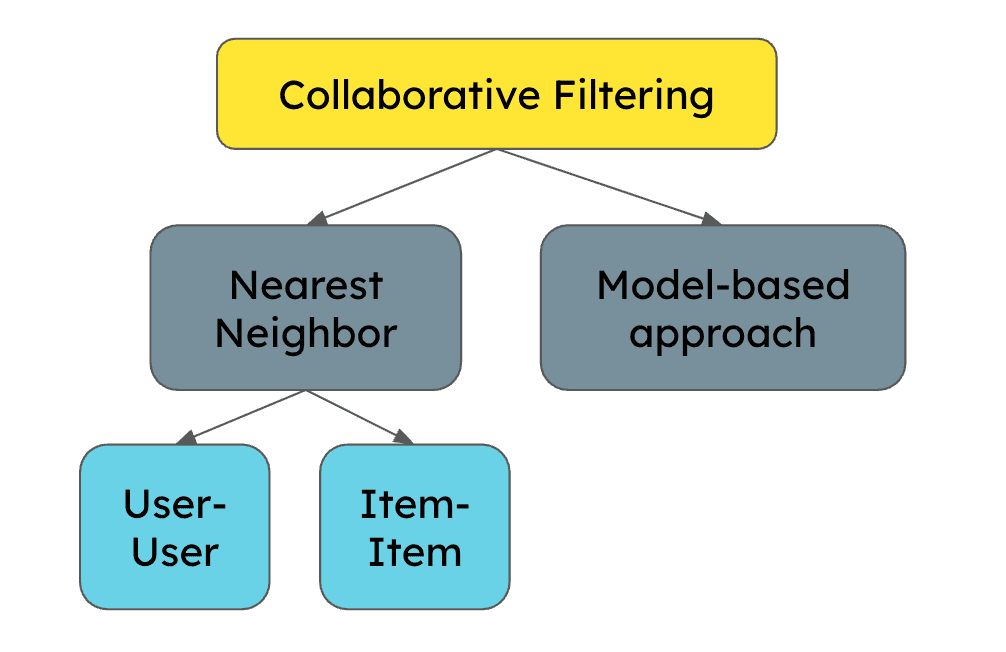
This family breaks into two approaches, which we explore in depth in the next section:
- Nearest Neighbor (memory-based): Directly computes similarity between users or items using their rating histories
- Model-based: Trains a predictive model (e.g., matrix factorization, neural network) on the interaction data
Key properties of collaborative filtering:
- Can surface serendipitous items the user wouldn't have found alone
- Does not require item feature engineering
- Limitation: Cold start for both new users and new items (hard to recommend items no one has rated)
- Limitation: Scalability (computing all pairwise user similarities is expensive at scale)
Hybrid Systems
Most production recommenders are hybrid systems that combine content-based and collaborative signals. The combination strategies include:
- Weighted hybridization: Scores from both systems are combined with learned weights
- Switching: Use content-based for cold-start users, switch to collaborative once enough history is available
- Feature augmentation: Use content features as inputs to a collaborative model (this is how most modern neural recommenders work)
Spotify uses your listening history to build a taste profile and finds other users with highly similar profiles to generate Discover Weekly. What type of recommendation approach is this closest to?