Inception, DenseNet, and the Efficiency Era
Inception: Why Choose One Filter Size? (2014)
VGGNet committed to 3 × 3 filters everywhere. Inception (GoogLeNet) took a different philosophical stance: you do not have to choose a single filter size per layer. What if you applied multiple filter sizes in parallel and let the network decide which representations are useful?
An Inception module applies 1 × 1, 3 × 3, and 5 × 5 convolutions simultaneously, along with max pooling, and concatenates all the results along the channel dimension. The 1 × 1 convolutions serve as bottlenecks, reducing channel dimensionality before the more expensive 3 × 3 and 5 × 5 operations — a trick that makes the module surprisingly parameter-efficient.
The result: at the 2014 ILSVRC challenge, Inception achieved state-of-the-art results with 12× fewer parameters than AlexNet and better accuracy. This made it not just an academic success but a practical one — smaller models deploy faster and cheaper.
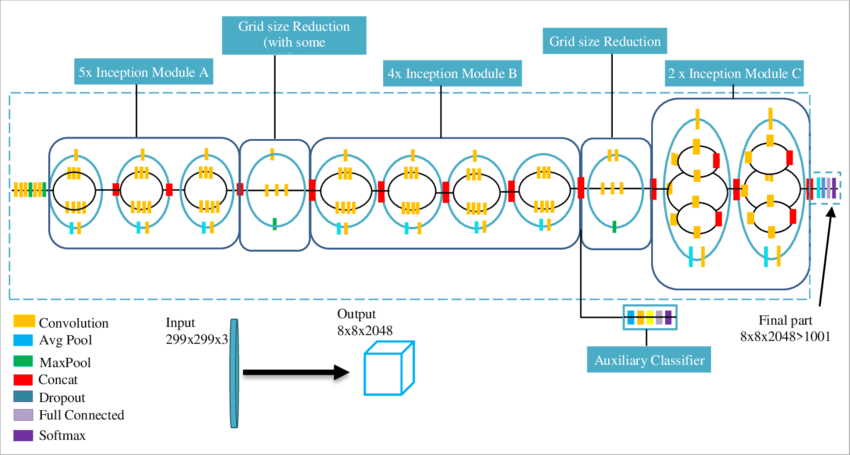
Hover over any component to learn what it does
The Inception module applies multiple filter sizes in parallel, letting the network learn at different scales simultaneously. Hover each component to explore its role.
DenseNet: Every Layer Connected to Every Other Layer
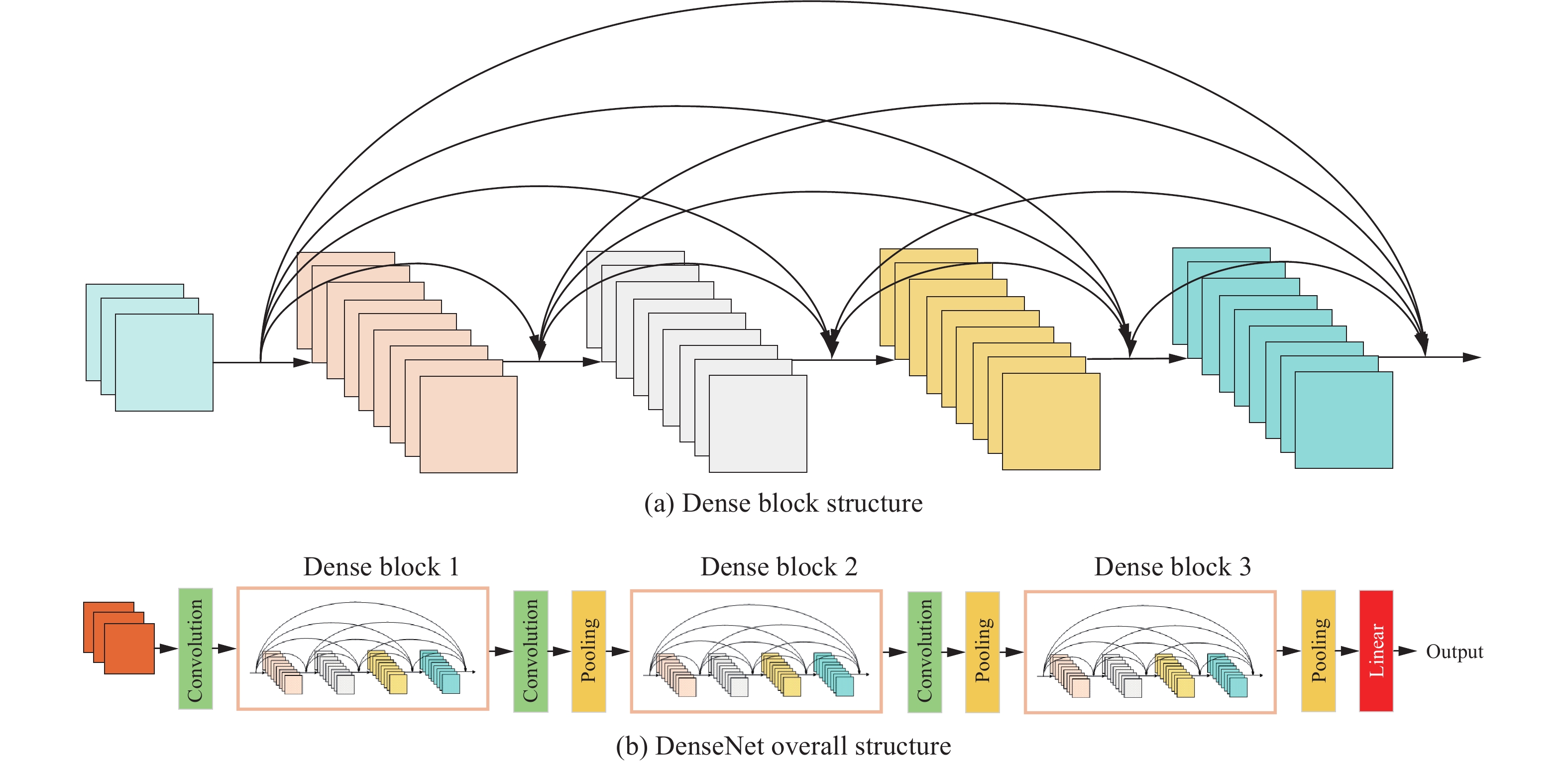
DenseNet takes the skip connection idea from ResNet and radicalizes it: every layer is connected to every other layer. In a network with L layers, there are L × (L+1) / 2 direct connections. Feature maps from layer 1 flow directly to layer 5. Feature maps from layer 3 flow directly to layer 7. All of them.
The benefits: alleviates vanishing gradient more aggressively than ResNet, and allows feature reuse throughout the entire network. The cost: significantly higher memory usage and a more complex hyperparameter landscape. DenseNet is powerful but demanding to train well.
SqueezeNet: Doing More With Less
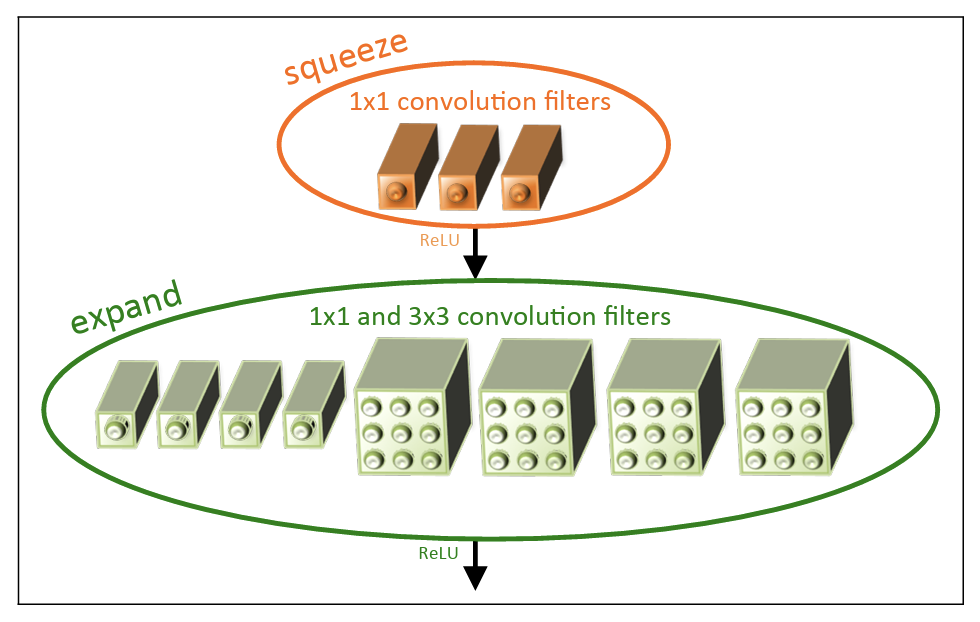
SqueezeNet is a masterclass in efficiency. By introducing a "squeeze" layer (1 × 1 convolutions to reduce channels) followed by an "expand" layer (a mix of 1 × 1 and 3 × 3 convolutions), SqueezeNet achieves competitive accuracy with dramatically fewer parameters than AlexNet — making it particularly useful for deployment on resource-constrained devices.
Real World: Mobile and Edge Deployment
SqueezeNet and MobileNet-family models are designed with mobile devices and IoT hardware in mind. When you are running inference on a smartphone or a factory sensor, model size and latency matter as much as accuracy. The architectural innovations of this era — bottleneck convolutions, depthwise separable convolutions — all reflect the pressure to do more with less compute.
You Don't Need to Implement These From Scratch
All of the architectures described in this chapter — AlexNet, VGGNet, ResNet variants, Inception, DenseNet, SqueezeNet — are available in PyTorch's Model Zoo and TensorFlow's Model Garden, often with pre-trained weights included. Transfer learning (the next chapter) makes this directly practical.
You are deploying a computer vision model to a microcontroller in an industrial sensor that has 512 KB of RAM and no GPU. Which architectural principles from this chapter would most directly guide your model selection?