Case Study: Netflix
Netflix is one of the most studied production recommendation systems in the world, in part because Netflix invited the world to study it. In 2006, they launched the Netflix Prize, a public competition to improve their rating predictions by 10%, and then published the outcomes. Since then, researchers and engineers at Netflix have continued to share unusually detailed accounts of what worked, what didn't, and why.
The Netflix Prize
In 2006, Netflix released a dataset of 100 million anonymized movie ratings and offered $1 million to whomever could beat the RMSE of their existing system (called Cinematch) by 10% or more. The competition ran for almost three years and attracted thousands of teams worldwide. It became the defining event of the recommender systems research community for that era.
The first Progress Prize went to the KorBell team after more than 2,000 hours of work (!), their winning submission combined 107 individual algorithms. Two techniques rose to the top as the highest-impact components: Matrix Factorization (which alone achieved an RMSE of 0.8914) and Restricted Boltzmann Machines (0.8990). Linearly blending just those two reached 0.88!
The ultimate Grand Prize solution, assembled from hundreds of models by multiple competing teams who merged forces, was a staggering engineering achievement. But Netflix made a pointed observation: the additional accuracy gains from the final solution did not justify the engineering effort to deploy it in production. A lesson they would revisit many times.
Key Insight: The 'Magic Barrier'
One of the most illuminating findings of the Netflix Prize was that there is a fundamental accuracy ceiling for rating prediction called the magic barrier, a limit imposed by the natural variability in human ratings themselves. Users are not internally consistent. Given the same movie at a different time, in a different mood, after a different day, the same person will rate it differently. This noise is irreducible by any algorithm. The magic barrier was relatively close to the 10% improvement threshold, which helps explain why so much effort was needed to cross that line, and why Netflix concluded that optimizing rating prediction alone was the wrong goal.
Everything is a Recommendation
Post-prize, Netflix's most important realization was that rating prediction was never really the right problem formulation to begin with. The actual goal is not to predict what score a user would give a movie. It is to get the right video in front of the right person at the right moment. That reframing changes everything.
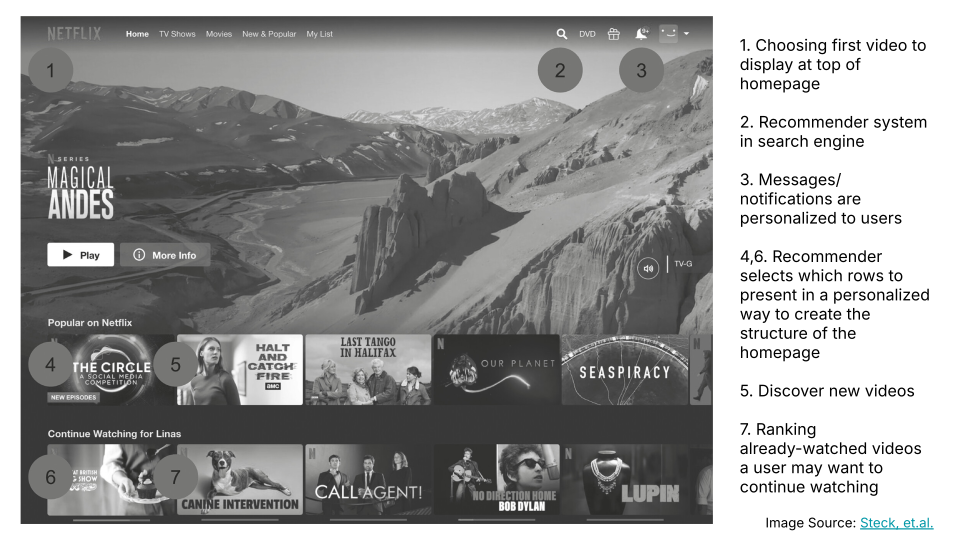
The Netflix homepage is not a single recommendation. It is a cascade of recommendation problems, each requiring its own algorithm:
- Which video should be displayed prominently at the very top?
- Which rows should appear on the page at all, and in what order?
- Within each row, which videos should be selected and how should they be ranked?
- Which search autocomplete suggestions should be personalized for this member?
- Which notifications and messages should be sent, and when?
- Which "continue watching" items should surface, and in what order?
There is no single model driving all of this. Netflix runs a dedicated algorithm for each personalization task, and these algorithms are independently designed, trained, and A/B tested. There is no silver bullet; which algorithm wins depends on the specific task and the available data.
Netflix runs a different algorithm for each personalization task on its homepage rather than a single unified model. What is the primary reason for this approach?
The Evolution: Rating Prediction → Ranking → Page Optimization
One of the most instructive narratives in the Amatriain & Basilico paper is the step-by-step evolution of how Netflix framed the recommendation problem. This evolution is a masterclass in knowing when to change your problem formulation.
Objective
Minimize RMSE on held-out ratings
Limitation
Predicts what a user who watched a video would rate it, not whether they'd watch it at all
Click each phase to see how Netflix's problem formulation, objective function, and system architecture changed across the three eras.
The shift from rating prediction to ranking is important. Using predicted rating as a ranking signal on its own leads to recommending niche items, things that a small subset of people who watched them would rate very highly. But most users wouldn't watch them in the first place. A good ranking function balances predicted enjoyment with popularity (the prior probability that any user will want to watch), and Netflix found that blending these two dimensions significantly outperformed either alone.
The further shift from ranking to page optimization acknowledges that users don't interact with items in isolation; they browse a two-dimensional grid. A video at position (row 2, column 1) is more likely to be seen and clicked than one at (row 4, column 3), independently of quality. Any system that ignores this attention structure will overestimate the impact of items that happen to end up in prominent positions (position bias) and underestimate items that are buried.
Netflix found that using predicted rating alone as a ranking signal was insufficient. A simple baseline instead combined predicted rating and item popularity as a linear scoring function. Why would pure predicted-rating ranking surface too many niche items, and why does blending popularity help?
Data at Scale
The diversity and scale of Netflix's data is a key part of what makes their system work. As of 2013, Netflix was processing approximately:
- 50 million play events per day: what was watched, for how long, on which device
- 5 million new ratings per day: explicit thumbs or stars feedback
- 3 million search queries per day: signals of intent and exploration
- Millions of queue additions, browsing events, mouse-overs, and scroll interactions
On the item side, Netflix's catalog is small relative to domains like e-commerce (thousands of professionally-produced titles vs. millions of products), but each title is richly annotated with manually curated tags describing mood (witty, dark, goofy), quality (critically-acclaimed, visually-striking), and storyline elements (time travel, talking animals). This human annotation investment would be impractical for a larger catalog but pays dividends in a domain where content quality is the core product.
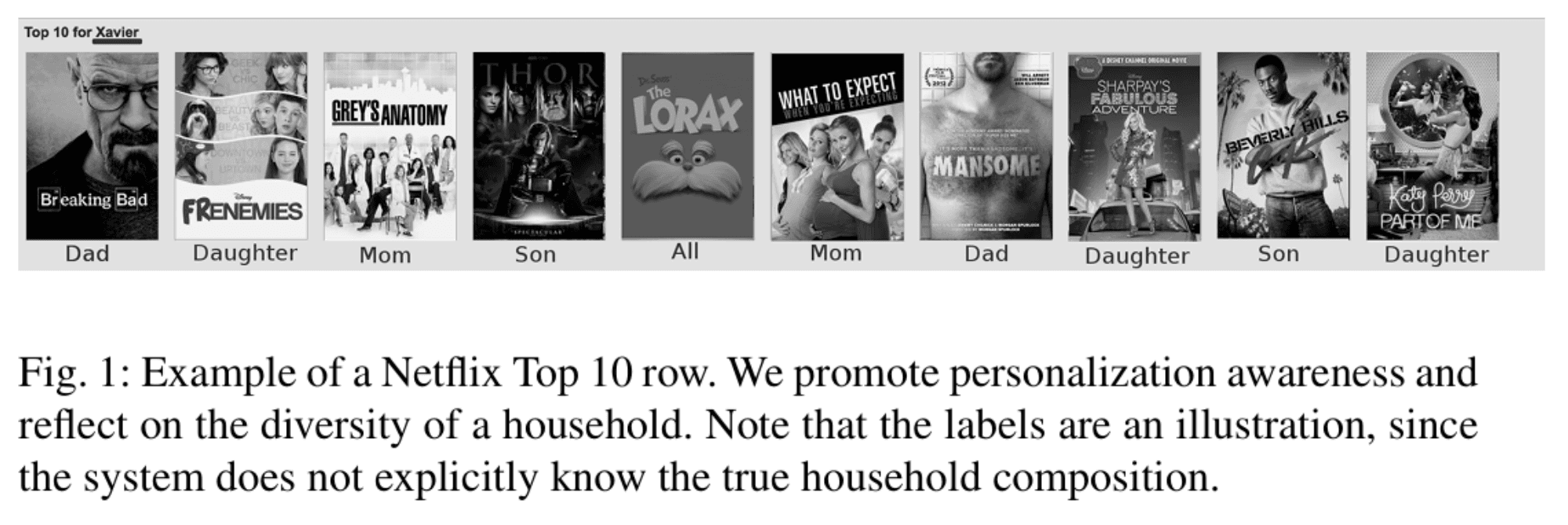
A critical but underappreciated data source is presentation and impression data: which items were shown to each user, where they were positioned on the page, and whether the user saw them. This is essential for handling presentation bias: a user who watches a video because it was placed prominently in their homepage provides weaker evidence of genuine preference than one who searched for and watched it deliberately. Without this data, a model confuses "was shown often" with "is liked."
The Missing-Not-At-Random Problem
Steck et al. (2021) emphasize a property of recommendation data that most academic datasets obscure: the observed entries in the user-item interaction matrix are missing not at random (MNAR). A user watches a video because the system recommended it. The system recommended it because the model predicted they'd like it. The model was trained on previous such data. This self-referential loop means that observed interactions reflect the choices of past recommenders, not an unbiased sample of user preferences. In fields like compressed sensing, the "missing at random" assumption is standard. In real recommender systems, it is violated in the most systematic way possible.
Consumer Data Science: The Offline–Online Testing Pipeline
Netflix's innovation process is built around a systematic combination of offline and online evaluation they call Consumer Data Science. The pipeline has two stages:
Stage 1: Offline testing. A new algorithm is evaluated on held-out historical data using multiple metrics simultaneously: ranking metrics (NDCG, MAP), classification metrics (precision, recall), regression metrics (RMSE), and diversity/coverage metrics. Offline testing is fast, it can evaluate a new idea in hours or days rather than months. Its purpose is to be a gatekeeping filter: quickly eliminate ideas that clearly don't work before they consume A/B test capacity.
Stage 2: Online A/B testing. Surviving ideas are deployed in a randomized controlled experiment. Users are randomly assigned to control (existing system) or treatment (new algorithm) groups. The primary evaluation criterion is long-term retention, whether members remain subscribers over time, not short-term engagement metrics like clicks. This is a consequential choice: it means A/B tests need to run for months to measure the effect, but it directly ties algorithm quality to business outcomes.
The offline–online combination exists for two reasons. First, engineering offline tests is far cheaper than online ones (no need to serve millions of users in real-time). Second, the pool of users available for A/B tests is a limited resource, allocating users to an experiment that has no offline signal of potential value is a waste of that resource. Offline testing acts as a quality filter before the expensive online gate.
System Architecture: Offline, Nearline, and Online
Delivering personalized recommendations to hundreds of millions of users at sub-200ms latency while continuously incorporating new interaction data is an engineering challenge as significant as the algorithmic one. Netflix's architecture divides computation into three tiers based on latency requirements:
- Offline computation: Runs in batch on Hadoop clusters with no real-time constraints. This is where expensive model training and bulk precomputation happens. Models are trained on the full history of interactions, and recommendation results are precomputed and stored for retrieval. The downside: results can go stale between updates because they don't incorporate the latest user actions.
- Online computation: Must complete within ~200ms for 99% of requests, as users are actively waiting. Assembles the final personalized page from precomputed results and real-time signals (what did this user do in the last few minutes?). Complexity is constrained by the latency budget; a fast fallback to precomputed results is always required in case of failure.
- Nearline computation: The middle tier: performs online-like computation in response to user events, but without a hard latency requirement, storing results for later retrieval. Examples: updating a user's "continue watching" queue the moment they start a new video; incrementally adjusting a user's genre weights based on recent plays. Nearline computation is also a natural home for incremental learning updates.
The three tiers are not mutually exclusive. A common pattern is to do the heavy lifting offline (model training, bulk candidate generation), leave the fresh personalization for nearline (embedding updates, recent-event weighting), and assemble the final result online (ranking the candidate set with real-time context).
A user finishes watching an episode of a TV series. Which tier of Netflix's architecture would be most appropriate to update their 'continue watching' row immediately, before their next session?
The Deep Learning Journey
When deep learning began dominating vision, speech, and NLP in the early 2010s, the natural question was whether it would do the same for recommenders. Netflix's answer, documented in Steck et al. (2021) with unusual candor, was: eventually yes, but not for the reasons anyone expected, and not without significant struggle.
Initial Disappointment: Well-Tuned Baselines Are Hard to Beat
The first finding was humbling. When applied to the "traditional" recommendation setup, using only user-item interaction data, deep learning models initially showed no significant improvement over well-tuned simpler methods. This is not because deep learning is weak; it is because in the traditional setup, the recommendation problem reduces to a representation learning task over two categorical variables (users and items), and a dot product is a remarkably efficient way to learn that. Requiring a deep network to relearn a dot product via multiple hidden layers is wasteful; the simpler model has a structural advantage.
This experience matched findings in the broader community, summarized by Ferrari Dacrema et al. (2019) in a paper titled "Are We Really Making Much Progress?", which showed that many neural recommendation papers failed to outperform properly-tuned neighborhood-based baselines.
Autoencoders as a Unifying Framework
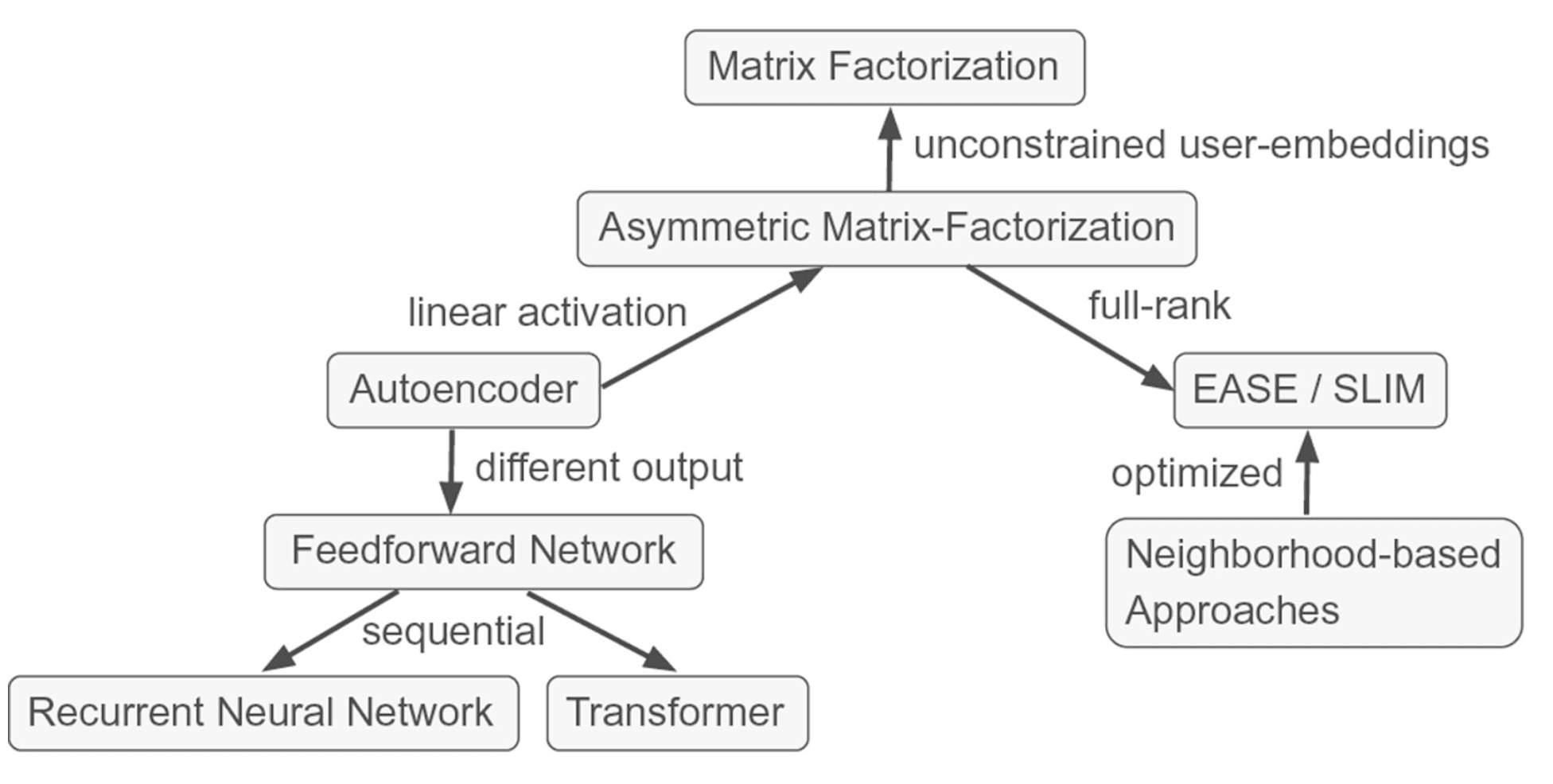
One productive outcome of this period was a clearer theoretical picture. Steck et al. show that many apparently unrelated recommender models are actually special cases of the autoencoder framework: Asymmetric Matrix Factorization is a linear autoencoder with a single hidden layer. Neighborhood-based approaches are a full-rank (non-low-rank) variant where the hidden layer size equals the number of items. EASE (Embarrassingly Shallow Autoencoders for Sparse Data) makes this explicit and provides a principled way to learn item-item similarity matrices. This unified view makes it easier to design new architectures for specific needs and to understand the tradeoffs between models.
The Breakthrough: Heterogeneous Features
Deep learning finally delivered at Netflix when the team stopped trying to do better on the traditional task and instead asked: what can deep learning enable that traditional models genuinely cannot do?
The answer was heterogeneous feature integration. When Netflix enriched the input data with additional features, time, device, context, content embeddings, deep learning models achieved very large gains. Traditional models like Matrix Factorization are bilinear and can only model pairwise interactions between the existing categorical features (users and items). Adding a new feature type requires significant manual engineering. Deep networks, by contrast, can learn higher-order interactions among an arbitrary mix of feature types in an end-to-end fashion.
Time is the most compelling example. Time carries multiple layers of cyclic structure: time of day (children's content peaks in the afternoon), day of week (TV shows vs. movies), seasonal effects (horror movies near Halloween), holidays. Representing this well requires a model that can learn these multi-scale patterns automatically rather than discretizing into hand-chosen buckets. Steck et al. report a gain of more than 30 percentage points in offline ranking metrics when using continuous time features versus discretized time, an illustration of deep learning's strength as a representation learner.
Bag-of-Items vs. Sequential Models
Within their deep learning work, Netflix found two complementary modeling paradigms useful for different tasks.
Bag-of-items models (analogous to bag-of-words in NLP) treat the user's interaction history as an unordered set. They are particularly effective for modeling a user's long-term stable interests: what genres they reliably return to, which actors they consistently seek out. An autoencoder is a natural fit here, it compresses a user's full interaction history into a dense latent representation and reconstructs predicted preferences over all items.
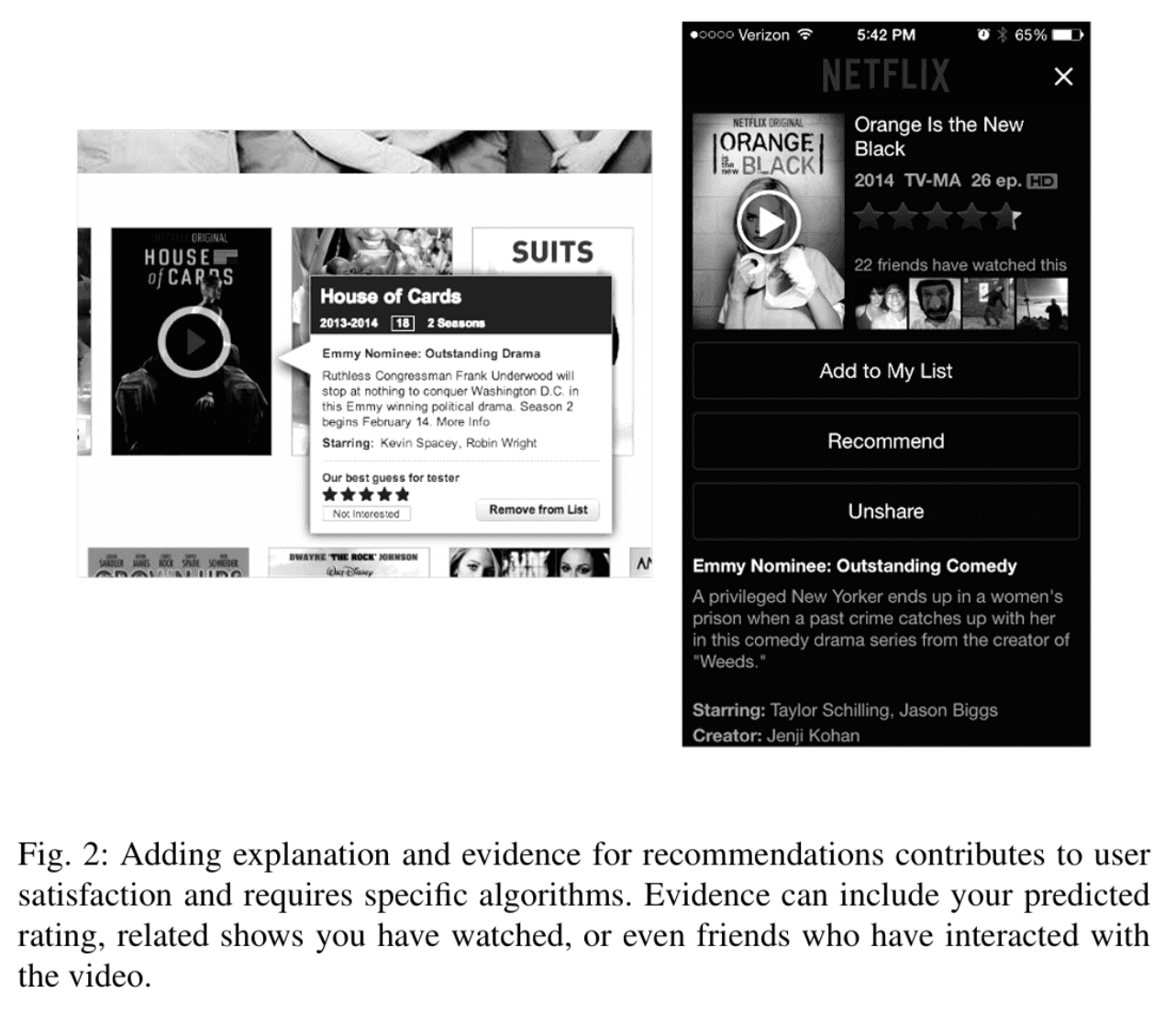
Sequential models (RNNs, LSTMs, Transformers) treat the interaction history as an ordered sequence and aim to predict the next item. They capture short-term context and session dynamics: the user who just watched three action movies is more likely to want another action movie tonight than their baseline genre profile suggests. Netflix experimented with n-gram models, LSTMs, GRUs, and transformer architectures (including BERT). A key advantage of the attention mechanism in transformers is that it provides a natural way to generate explanations, the attention weights show which past interactions most influenced the current recommendation.
The Offline–Online Metric Mismatch Problem
Perhaps the most practically important finding in Steck et al. (2021) is a warning about deep learning's relationship with proxy metrics. When deep learning models finally started showing large improvements in offline metrics, the team discovered that these gains did not always translate to A/B test performance. In some cases the offline gain disappeared online. In rare cases the model actually performed worse.
This mismatch is not unique to deep learning! It exists for all recommendation models to some degree. But deep learning makes it worse for a specific reason: more powerful models solve the given problem more accurately. If the offline metric (e.g., clicks or plays on a held-out set) is a good proxy for long-term satisfaction, a more powerful model improving on it is good. If the offline metric is a flawed proxy, optimizing for it actually moves away from true user satisfaction in some range, a more powerful model will diverge further from the goal than a weaker one would.
Three manifestations of this problem:
- Short-term vs. long-term objective mismatch: Optimizing for short-term proxy metrics (plays, clicks) can diverge from long-term retention. A model that maximally exploits short-term signals may recommend content that drives immediate engagement but leaves users feeling hollow, contributing to churn rather than preventing it.
- Distribution mismatch (covariate shift): The training data distribution reflects users who received the previous system's recommendations. A new model trained on this data is being trained and evaluated on a distribution it will not see in deployment. Deep models are more sensitive to this than shallow ones.
- Fairness and hidden biases: Deep models can find patterns in the training data that reflect historical biases (e.g., over-representing certain demographics in the data) and amplify them. These biases may not be visible in aggregate offline metrics.
Breaking the Feedback Loop
Netflix's recommendation system is trained on data generated by a previous version of itself: users watch what they were recommended, and those watches become training examples. This creates a feedback loop where the system gradually narrows what it shows users, reinforcing existing patterns. Two approaches Netflix found effective for (partially) breaking this loop: contextual bandits, which intentionally introduce some randomness into recommendations to gather unbiased exploration data; and training on search behavior, since videos discovered through search weren't influenced by the recommendation system, providing a cleaner signal. Neither fully solves the problem, but together they substantially reduce its severity.
A Netflix engineer trains a new deep learning model that shows a 15% improvement in offline NDCG@10 over the current production model, but the A/B test shows no significant difference in retention. Which of the following is the most likely explanation?
Practical Takeaways
Across both papers, a set of generalizable lessons emerge from Netflix's two-decade journey:
- Match the problem formulation to the actual goal. Rating prediction was a tractable proxy for the Netflix Prize, but the real goal is retention. Every time Netflix redefined the problem more precisely, from rating prediction to ranking to page optimization, they got more value. Ask whether your current metric is what you actually care about.
- Well-tuned baselines are ruthlessly competitive. Deep learning will not automatically beat a properly tuned matrix factorization model on the traditional recommendation task. Before adding model complexity, invest in tuning your baseline.
- Deep learning earns its keep on representation problems. The gains come from heterogeneous features, not from depth alone. If you only have user-item interaction data, a shallow model may be your best option.
- Take offline–online metric alignment seriously. Large offline improvements do not reliably predict online gains. Invest in offline metrics that better proxy long-term outcomes, and use A/B tests as the ultimate arbiter.
- Architecture matters as much as algorithm. A brilliant algorithm that can't serve 200ms recommendations is useless in production. The offline/nearline/online tier design is as important as the model itself.
- Feedback loops are real and dangerous. If your system trains on its own outputs, it will drift. Build in exploration mechanisms and monitor for distributional shift.
- The ML ecosystem is underrated. One of the practical benefits Netflix found from adopting deep learning was access to mature, standardized tooling (TensorFlow, PyTorch): automatic differentiation, GPU scaling, built-in monitoring. The engineering ecosystem around the model can be as impactful as the model itself.
The Sources
Amatriain & Basilico (2012): "Recommender Systems in Industry: A Netflix Case Study." Written by two Netflix engineers shortly after the prize era, covering the full spectrum from data and models to architecture and evaluation methodology.
Steck et al. (2021): "Deep Learning for Recommender Systems: A Netflix Case Study." AI Magazine. A candid account of Netflix's decade-long effort to make deep learning work for recommendations, including the failures and the eventual breakthroughs.
Steck et al. (2021) found that deep learning at Netflix only started outperforming well-tuned traditional methods when heterogeneous features were added. Why does simply applying a deeper architecture to the same user-item interaction data fail to help, and what does this tell you about when to reach for deep learning vs. when not to?