Loss Functions
To improve, you need to know how wrong you are. That is the job of the loss function (also called a cost function, though technically the loss function applies to a single example while the cost function is the average loss across the entire training set — in practice, these terms are used interchangeably).
Consider a simple example: you are training a model to count blueberries in a muffin from an image. Your model looks at the image and predicts 2 blueberries. The actual label is 4. Your error is 2. The loss function formalizes and quantifies that error.
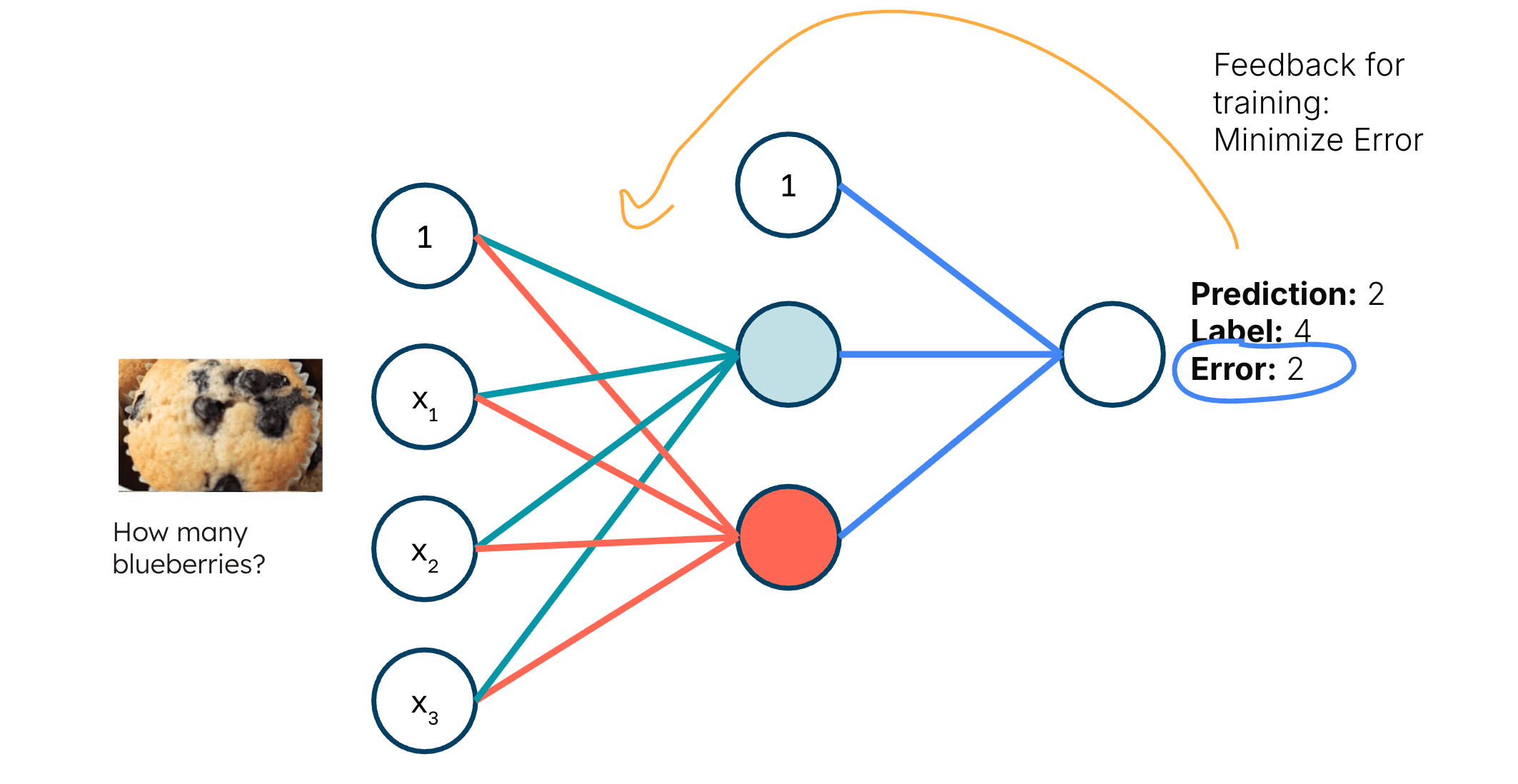
Common Loss Functions for Regression
-
Mean Squared Error (MSE)
Squares the error, so large errors are penalized heavily. Use this when outlier errors are genuinely costly — house price prediction, energy consumption forecasting.
-
Mean Absolute Error (MAE)
Takes the absolute value of the error, treating all errors proportionally. Use when outlier errors should not dominate training — food delivery time prediction, where one delayed package should not distort the entire model.
-
Huber Loss
A hybrid that behaves like MSE for small errors and MAE for large errors. More robust than MSE but adds a threshold hyperparameter .
Common Loss Functions for Classification
-
Binary Cross-Entropy
Used when you have exactly two classes (spam/not spam, dog/not dog). Measures the divergence between the predicted probability distribution and the true distribution.
-
Categorical Cross-Entropy
Used when you have more than two classes. Generalizes binary cross-entropy to the multi-class case.
On Custom Loss Functions
In industry, custom loss functions are often where the real performance gains hide. The standard loss functions treat all errors symmetrically. In many real problems, errors are not symmetric — missing a fraud case is far worse than a false alarm. When you are comfortable with the basics, building custom loss functions that encode your problem's actual cost structure can dramatically improve model alignment with real-world objectives. PyTorch and TensorFlow both make custom loss functions straightforward to implement.
Real-World Application
The choice of loss function is a design decision that encodes what you care about. Choosing MSE implicitly says "I care a lot about large errors." Choosing MAE says "I want all errors treated equally." If you are building a medical model that predicts disease severity, and a missed severe case is catastrophic while a false alarm is merely inconvenient, your loss function should reflect that asymmetry.
You are training a model to predict food delivery times in minutes. Occasionally, one delivery is 2 hours late due to a restaurant error — an outlier that has nothing to do with the model. Which loss function is the better choice, and why?